John Sheen has been collecting First World War militaria with a North East connection for many years, and has written several books including books on the Durham Pals and the Tyneside Irish. He is sharing his collection of photographs and postcards with the Durham at War project. Here, John talks about how he became interested in the First World War.
 |
| Private Walter Sheen of the 8th Green Howards With many thanks to John Sheen, from his personal collection (A001) |
Researching World War One has been a very long term project for me. Back in the early 1950s I was visiting my paternal grandmother, together we were looking at the photographs on her sideboard, of my father and his brothers, all in battledress uniform. On the end was a photograph of a man in a different uniform, and I asked, “Who is this Gran?”
'That's your Grandfather, he was in the Green Howards, by those lads could fight, but not like the Tyneside Irish', she replied. I had heard of the Green Howards but not of the Tyneside Irish, so I asked “what’s the Tyneside Irish?' Your great grandfather, my father was in the Tyneside Irish, the best fighting Regiment in the Great War”. With that remark tears came into her eyes and she clouted me across the head and told me to mind my own business. Why had I got a clout because of the Tyneside Irish? From that day I wanted to know more about these men.
That started it, first it was collecting cap badges and odd bits of militaria, then after getting married I moved into family history – but it was always the Tyneside Irish that fascinated me. I began cross-referencing as many sources I could find on the brigade and over time built up a handwritten nominal roll of over 7,000 names cross referenced against seventy sources.
When I left the army in 1992, Steve Shannon asked me to do a talk on the brigade at the DLI museum. I remember that day very well. So many people with family stories to tell, the man with a German bullet wedged in the strings of the Tyneside Irish harp cut from his dead uncle’s tunic. Of course all that led to the book, which gave me the writing bug and I went on to do another five on North East units and one about the German advance in 1918.
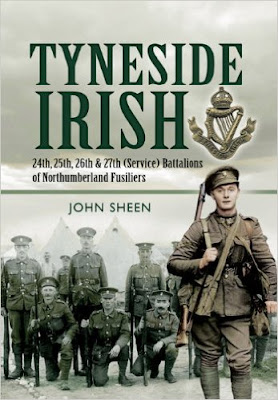 |
| Cover of the Tyneside Irish, by John Sheen |
But how things have changed over the years! I can now do in one evening in my bedroom, work that would have taken a whole week at Kew. When I came to Durham on leave in the 1980s I would visit the Record Office and extract names ranks and numbers from the Absent Voters List, how lucky we are in County Durham that so many have survived.
But this Durham at War project has taken it to a whole new level, now I don’t stop at the military research for my photos but get back into the census returns and learn more about the men’s lives before they joined up.
But here I would like to thank the project intern, Candela*, for all the hard work she has put in adding the photos to the site.
*Candela’s internship has now ended but look out for a blog post by her in the future.


